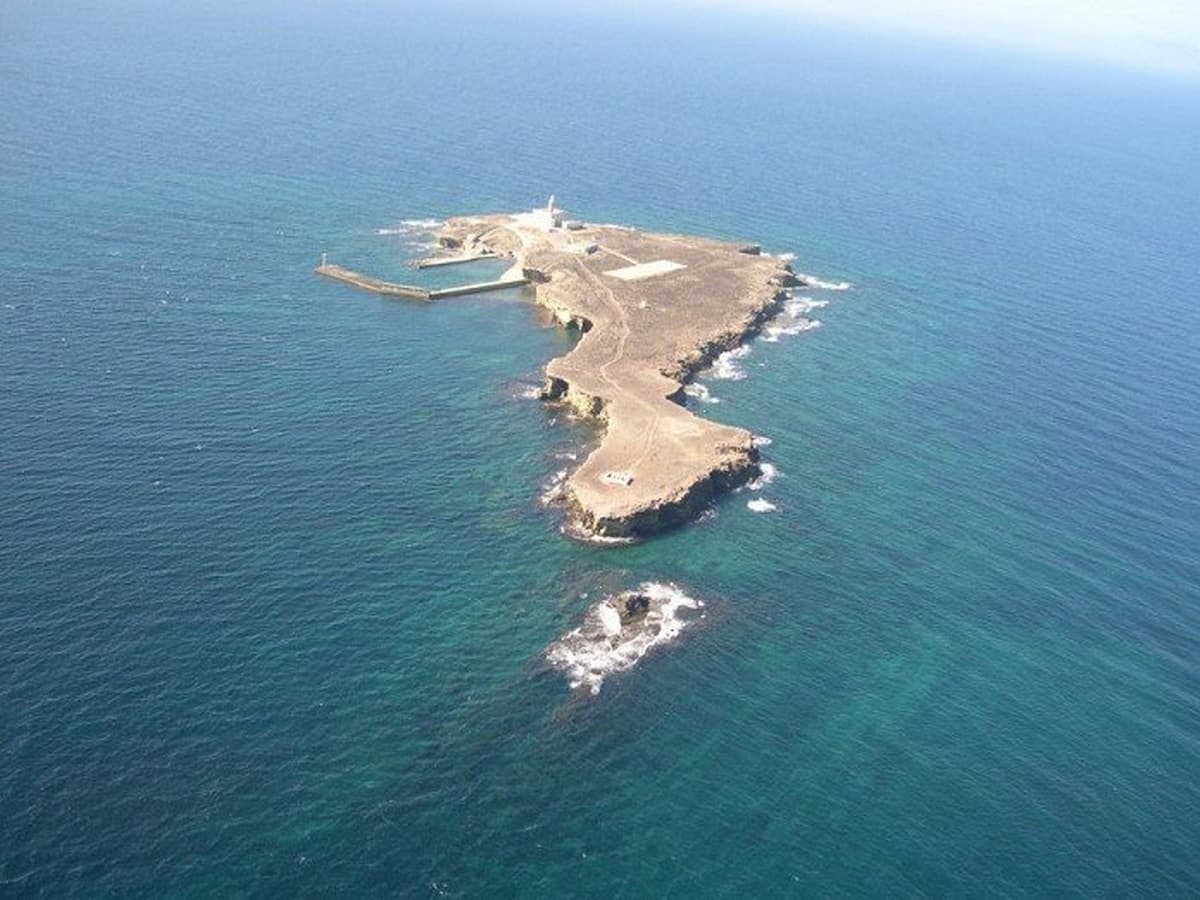
Alborán Island
Why visit Alborán Island
Named after a pirate, bombed by accident, occupied to keep out the Soviets
Isla de Alborán is a flat volcanic speck in the middle of the Alboran Sea, sitting 56 kilometres north of Morocco and 85 kilometres south of Almería, belonging to neither shore in particular but firmly to Spain since 1540. The island takes its name from a Tunisian corsair called Mustafa al-Borani, meaning "thunderstorm" in Turkish, who used it as a base for raids until a Spanish fleet ended his operation at the Battle of Alborán on 1 October 1540. It has been Spanish ever since.
A lighthouse, a cemetery and an accidental bombing
The main structures are a lighthouse, inaugurated in 1876 after years of construction, a small harbour, and a cemetery. Early in the Second World War, British bomber crews flying at night mistook the flat island with its single building for a surfaced submarine and bombed it. No serious damage was recorded. In the 1960s, Soviet fishing vessels made repeated attempts to gain a foothold on the island, which prompted Spain to install a permanent Spanish Navy detachment in 1963. That garrison remains today, administering an island that belongs to the municipality of Almería and the district of Pescadería.
Back from the dead, one plant at a time
Alborán punches far above its 7 hectares in ecological significance. It is a Specially Protected Area of Mediterranean Importance under United Nations designation, part of the EU Natura 2000 network, and an Important Bird Area supporting one of the world's largest colonies of Audouin's gulls. The island is the only known wild home of Diplotaxis siettiana, a wall-rocket plant endemic to this single speck of rock. The species was considered extinct in the wild by the 1980s; seeds collected in 1974 were used to grow plants in captivity, and a successful reintroduction took place in 1999.
A military island with no public access
Access to Isla de Alborán is restricted to military personnel and authorised researchers. There is no civilian infrastructure, no transport service and no way for the public to visit. Unlike the plazas de soberanía on the Moroccan coast, Morocco does not formally contest Spanish sovereignty over Alborán, which sits far enough into open sea to sit outside the scope of Moroccan territorial claims. The island gives its name to the entire Alboran Sea and, by extension, to the oceanic gyre, the rock type alboranite discovered here in 1899, and to the sea's most important cetacean feeding grounds.
Experiences in Alborán Island
WānaTravel partners with Viator and GetYourGuide so you can browse and book experiences directly. Prefer a personal touch? Contact WānaTravel and we'll add it to your itinerary for you.
Practical Information
Travel essentials, government safety advisories and The Out Index score for Alborán Island.

Out Score of Alborán Island
Alborán Island has not received an Out Score yet.
Out Score of Alborán Island
Alborán Island has not received an Out Score yet.
N/A
Tier N/A